I'm just going to say it: your ceiling probably has too many lights.
You know what I'm talking about. Those little recessed lights—sometimes called can lights—arranged in perfectly spaced rows across the ceiling. Six in the living room, eight in the kitchen, another five down the hallway. Before you know it, your ceiling looks like an airport runway!
And for years, we've been doing this in practically every new home. Especially luxury homes, where apparently the solution to every lighting question was simply to add another recessed light.
Don't get me wrong, I like recessed lighting. It's clean, functional and sometimes exactly what a room needs. But somewhere along the way, we started treating recessed lights as the entire lighting plan instead of just one component of it.
Well, designers are finally pushing back.
In recent 2026 design reporting, VERANDA and House Beautiful have both explored the move away from repetitive recessed-light grids and toward lighting that actually contributes to the architecture and personality of a room.
And one designer interviewed by VERANDA had a particularly funny way of describing the problem: no one wants a ceiling that looks like Swiss cheese! She's got a point.
Here's the issue with recessed lighting. It's typically installed in evenly spaced grids, often without enough consideration for furniture placement, architectural details or what homeowners actually want to illuminate. The result? Everything gets lit equally—the sofa, the floor, the coffee table, the empty corner. Everything!
But beautiful rooms aren't necessarily illuminated evenly. Think about your favorite restaurant, a beautiful hotel lobby or even an intimate dining room. They often use shadows, contrast and carefully placed pools of light to create atmosphere. That variation is what gives a room depth. And that's precisely what a ceiling full of recessed lights can take away.
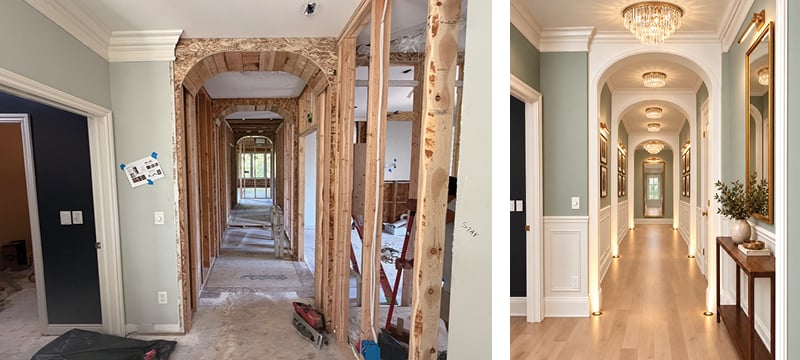
📸 LEFT: My long hallway, under construction.
📸 RIGHT: An AI rendering of the layered lighting without a single can light.
Ya, I’m putting this theory to the test in my own home. As many of you know, I'm in the middle of a fairly significant remodel. And one of my favorite design projects has been reimagining the lighting in our long hallway.
We have nine-foot ceilings and three architectural arches running through the space. Originally, the lighting plan included recessed ceiling lights. Pretty standard. Nothing necessarily wrong with them. But I kept looking at those arches, the architectural details and the long sightlines through the hallway, wondering why I would want the ceiling covered in little circles. So, I eliminated the recessed lights entirely.
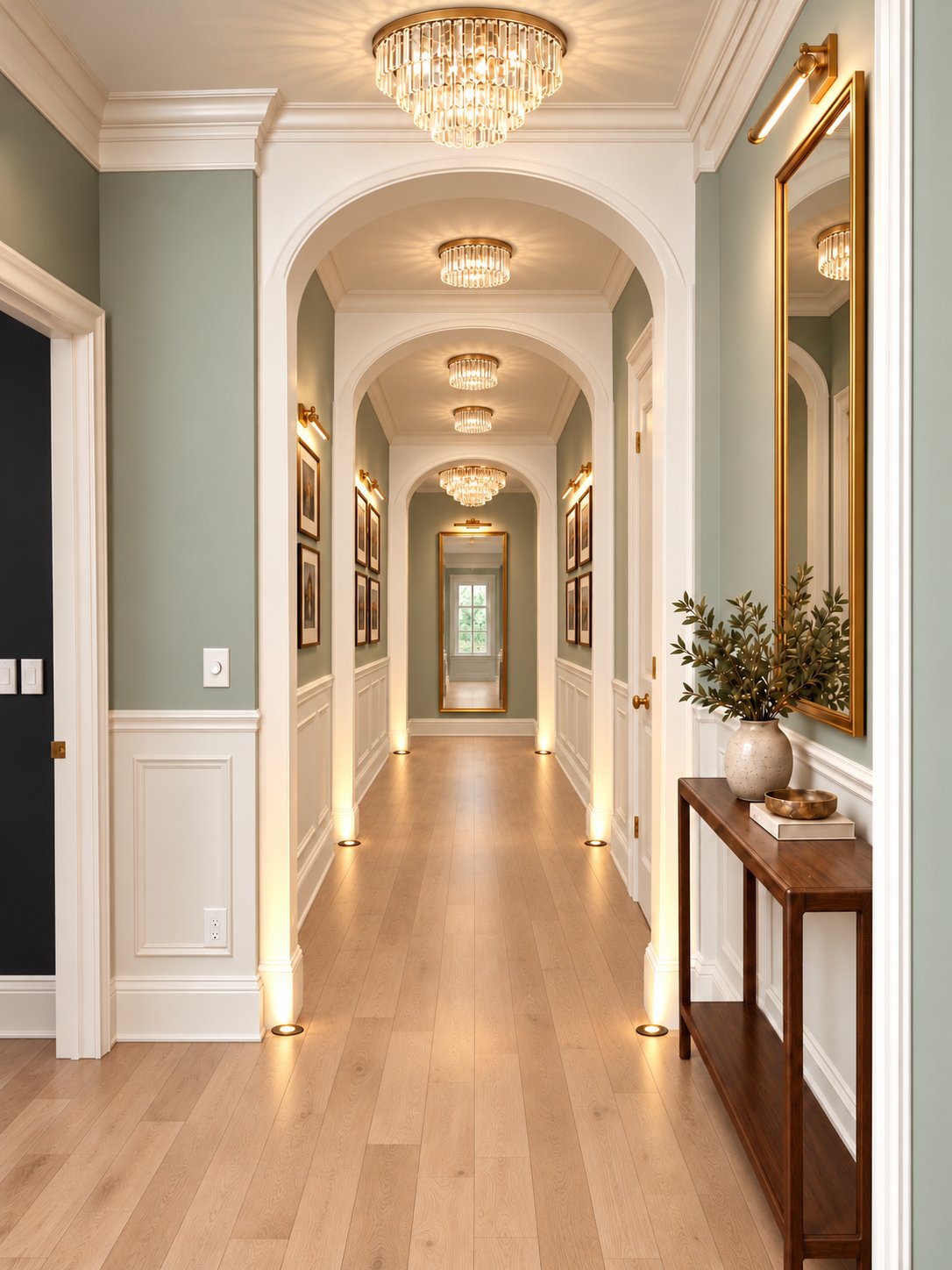
Instead, I'm using two tiered chandeliers, three additional decorative chandeliers, picture lighting to illuminate artwork and family photos, and six small floor-mounted uplights positioned at the bases of the arches.
Yes, technically I'm replacing a handful of recessed lights with a LOT more light fixtures! But here's the difference: each one has a purpose. The chandeliers provide general illumination while also becoming part of the design. The picture lights draw your eye to artwork and photographs. And the uplights wash the arches with light, emphasizing architectural details that would otherwise disappear at night.
Instead of illuminating everything from overhead, I'm creating different layers of light throughout the space. Will I love every detail when it's finished? We'll see! But that's the fun of designing your own home. And it brings me to what I think is the biggest misconception about residential lighting.
The problem isn't necessarily too much light. It's too much light coming from one place.
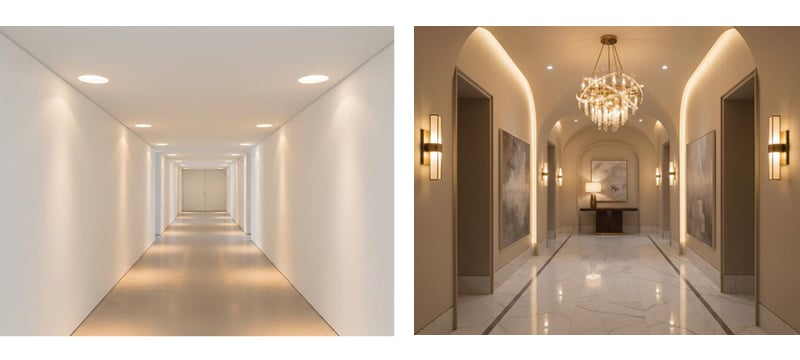
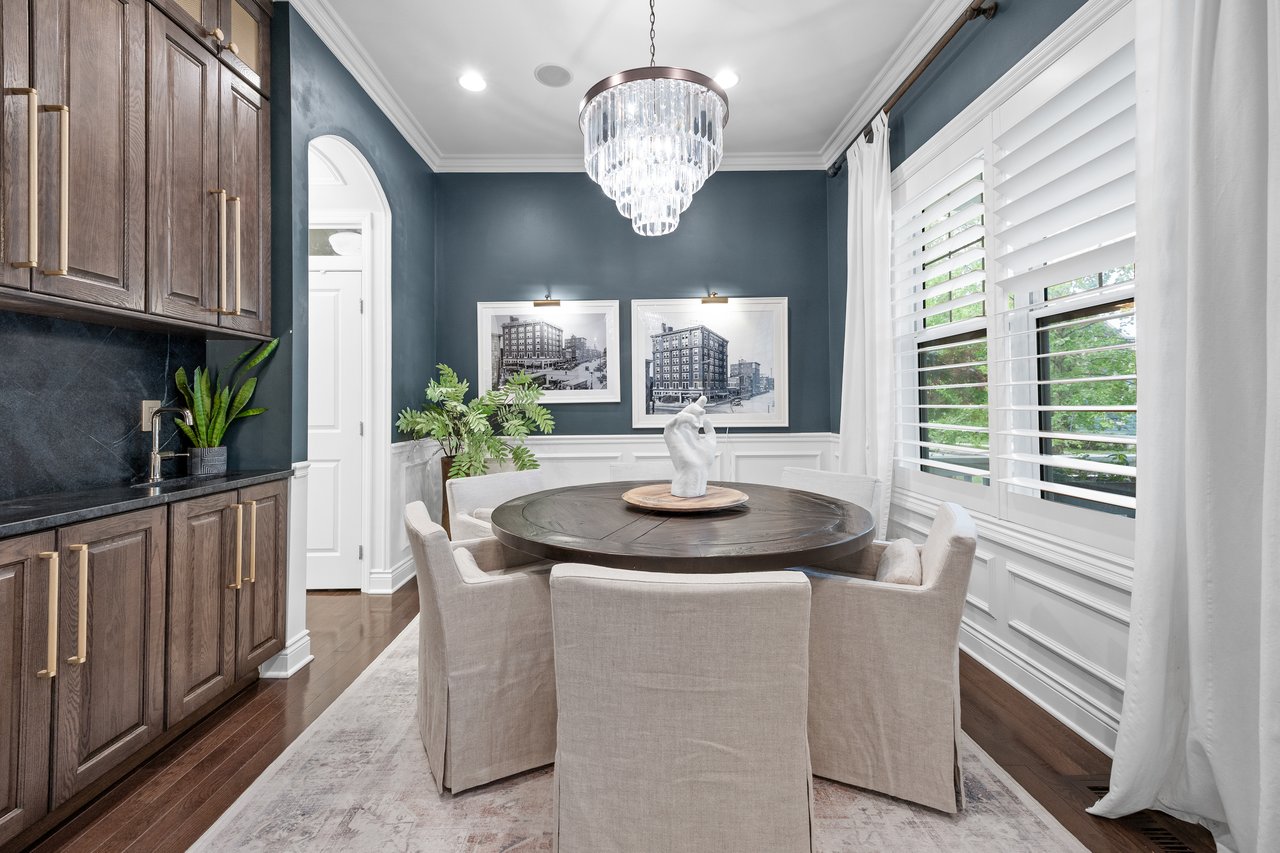
📸 LEFT: The old approach - Uniform recessed ceiling lighting emphasizes brightness and repetition.
📸 RIGHT: The layered approach - Decorative fixtures and architectural lighting create visual depth and focal points.
The three layers of good lighting. Designers generally divide lighting into three categories: ambient, task and accent. And understanding the differences might be the easiest way to improve almost any room.
1. Ambient lighting: the light that lets you see.
This is your general illumination. Chandeliers, ceiling fixtures, concealed cove lighting and yes, recessed lights can all contribute to it. The goal is to comfortably illuminate a space without creating harsh glare or excessive brightness.
2. Task lighting: the light that helps you do something.
Think under-cabinet lights in a kitchen, sconces beside a bathroom mirror or a reading lamp next to your favorite chair. Task lighting is intentionally directed where you actually need it. This is one reason I still love recessed fixtures in kitchens: properly located lights can illuminate countertops without becoming a dominant feature of the ceiling.
3. Accent lighting: the light that creates the magic.
Picture lights, wall washers, shelf lighting, uplights and carefully placed lamps can all highlight architectural details, artwork and decorative objects. This is where rooms start feeling intentional rather than simply bright.
And here's the beauty of layering: you don't need every light turned on simultaneously. You might want brighter, practical lighting when cleaning the house, warmer illumination when entertaining and just a few accent lights when relaxing in the evening. Same room. Completely different feeling.
Okay, so then I started looking into the research which was actually pretty fascinating. Lighting manufacturer Lutron released its 2026 Luxury Residential Trend Report, and one statistic really caught my attention.
47% of surveyed residential designers and architects believe poor lighting design can diminish even the most expensive architecture and finishes.
Think about that. You could spend a fortune on beautiful hardwood floors, custom cabinetry, natural stone and architectural millwork, only to undermine the entire room with poorly planned lighting! The report also found that 94% of surveyed designers and architects believe their clients consider lighting highly important. And perhaps most interestingly, 60% of affluent homeowners surveyed said they adjust lighting depending on their mood or time of day. Lighting isn't simply about visibility anymore. It's about how a space makes us feel.
Which explains why designers are becoming increasingly interested in decorative fixtures, concealed lighting, better dimming systems and even technology that automatically adjusts the color and intensity of light throughout the day.
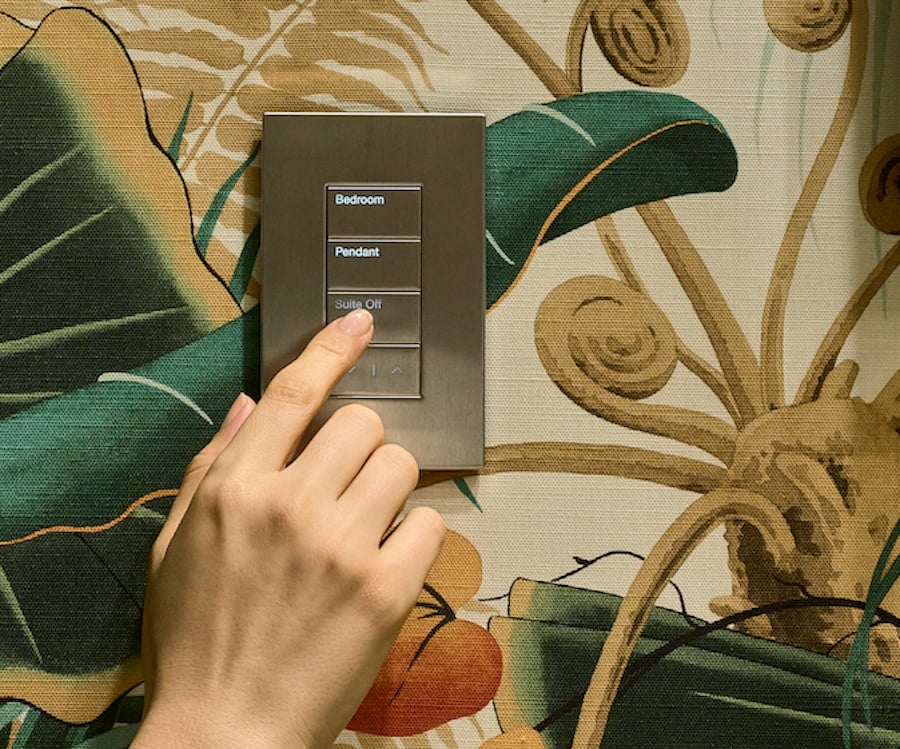
And please…put your lights on dimmers! If there's one relatively simple improvement I'd recommend to almost any homeowner, it's better lighting control. Think about how differently you use your kitchen throughout the day.
In the morning, you might want bright lighting while preparing breakfast. By evening, you might want the pendants over the island dimmed, some under-cabinet lighting and a few decorative fixtures creating a warmer atmosphere. Same kitchen, two entirely different experiences.
And don't overlook color temperature. For most living spaces, I tend to prefer warmer lighting, generally around 2700K to 3000K. Higher color temperatures can be useful in certain task-oriented areas, but overly cool lighting can make a beautiful home feel surprisingly clinical. It's also worth paying attention to how well light renders colors. High-quality bulbs with good color rendering help paint, wood, artwork and skin tones appear more natural. After all, what's the point of selecting the perfect white paint if your lighting makes it look green?
Some of you are asking, should we stop installing recessed lights? Absolutely not.
Recessed lighting remains incredibly useful, especially in kitchens, utility areas, rooms with lower ceilings and places where you need focused light without a visible fixture. And in contemporary homes, thoughtfully positioned, small-aperture recessed fixtures can look beautiful. The issue isn't the fixture itself. It's the habit of installing them everywhere simply because that's what we've always done.
Next time you're designing a room, renovating or building a home, I'd encourage you to ask a different question. Instead of, "How many lights do we need in the ceiling?” Ask, "What do I want people to notice when they walk into this room?"
Maybe it's a stone fireplace. A piece of artwork. Beautiful cabinetry. A textured wall. Or perhaps, like my hallway, a series of architectural arches. Then design the lighting to celebrate those features. Because great lighting shouldn't simply make a room brighter. It should make the room better. And your ceiling shouldn't need twelve little holes to prove it.