"We are glad this proposal will both provide needed assisted living facilities and maintain the integrity of an important and beloved natural space."
Laura Goddard said that as treasurer of the Friends of Hickory Hill Park board, weighing in on a senior living campus proposed on land bordering the park's east side. The council had already rejected an earlier version of that same plan once, citing concerns over cul-de-sacs, buffers separating the park from the development, and the climate impact on the park itself. What finally won the Friends over wasn't a smaller building. It was a deal that handed the park nearly 40 acres it had never owned before, at no cost to the city and no line item on any parks budget.
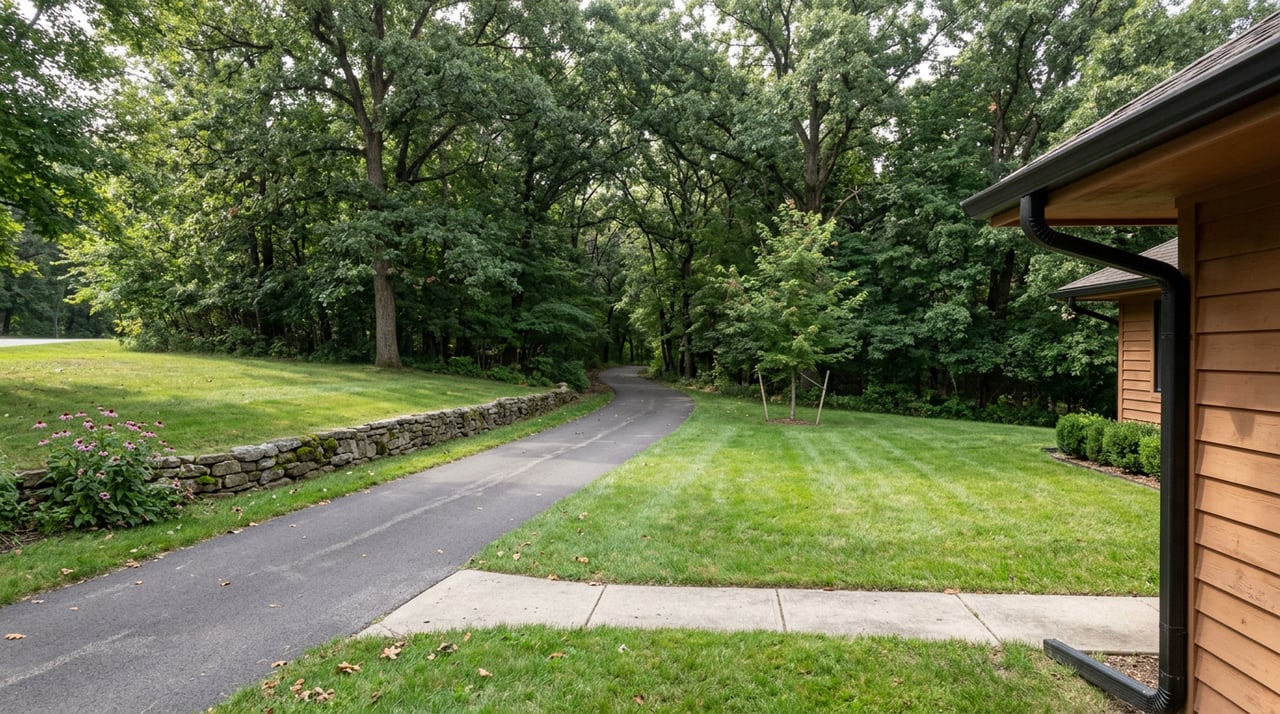
If you walk this park regularly, you already know something changed this year. There's been fencing along parts of the trail system since spring, a paved surface where there used to be dirt and wood chip, and a stretch of the loop that looks nothing like it did in 2024. What most walkers don't know is that the fencing and the land gift are two chapters of the same story, five years apart, and together they represent the most significant change to Hickory Hill Park's footprint and infrastructure since the city finished dealing with stormwater easements in the early 1990s.
A Park Built By Purchase, Then One Gift That Broke the Pattern
Every acre Hickory Hill Park has ever held came from a transaction the city initiated and paid for. The original 40-acre core was purchased in 1927 with bonds meant to expand the adjacent Oakland Cemetery, then left to grow wild when the cemetery didn't need it. Fifty more acres arrived in 1952. A small tract near the Bloomington Street entrance was dedicated in 1968 using federal money, the same year the park was formally established. Two more expansions followed in the early 1980s, one of them nearly 50 acres on the park's east side, both funded through a federal stormwater management grant rather than a straightforward land purchase. A final piece, just under 33 acres, was dedicated in 2000.
Read that list again and the pattern is consistent: bonds, federal grants, city budgets. The land never showed up as a gift.
That changed in November 2021, when the Iowa City Council approved a rezoning that let a developer build a 120-unit assisted living and memory care community, now known as StoryPoint Hickory Hill, on 8.85 acres at the edge of the site. The remaining acreage, close to 38 acres according to the project's builder, Nelson Construction and Development, went to the city as open space, folded permanently into Hickory Hill Park. Nelson's own project page for the development calls it the largest land donation in the park's history, and the distinction matters: not the largest expansion by acreage (the 1982 stormwater tract and the 1952 purchase were both bigger), but the first time a private developer, rather than a bond issue or a federal grant, was the one writing off the land.
Council member Laura Bergus called the outcome "shockingly good" given how contentious the earlier version of the proposal had been. Mayor Bruce Teague pointed to the alignment between the council, the developer, and the neighborhood as unusual. Development services coordinator Danielle Sitzman told the Corridor Business Journal at the time that the city's intention was to keep the new acreage from ever being developed again.
Three numbers tell the size story cleanly:
- 50 acres: added in 1952, the largest single expansion in the park's history by acreage
- 49 acres: added in 1982 on the east side, originally intended for stormwater retention
- 38 acres: donated in 2021, smaller than either of those but the first to arrive as a gift rather than a purchase
The park sits at roughly 190 acres today, according to Wikipedia's entry on the property, a figure built from nearly a century of these additions stacked one on top of the last.
The Decade-Old Plan That's Finally Getting Built
The other change residents have noticed this year has nothing to do with the FeatherStone or StoryPoint land. It traces back to a master plan the city adopted in 2016, developed with the engineering firm Snyder and Associates alongside city staff and the Friends of Hickory Hill Park. That plan divided the park's future trails into three tiers: primitive trails of bare ground or wood chip, granular secondary trails for maintenance access, and a small mileage of paved primary trail built to Americans with Disabilities Act standards, the first fully accessible route the park has ever had.
Ten years passed before that top tier broke ground. According to the city's construction project page, work on Phase 1 began May 13, 2026: an approximately 0.9-mile, 10-foot-wide multiuse trail, with the city targeting completion by fall 2026. Residents near the construction zone were told to expect limited driveway access at points during the build, with notice given ahead of any disruption. As of this fall, the segment is in its final stretch, the first time in the park's history that any portion of its trail network has been built to that paved, ADA-compliant standard rather than left as the limestone, wood chip, and dirt surfaces that define the rest of the loop.
For a park that has spent a century staying deliberately unpolished, a paved primary trail is a real departure. It's also, notably, unrelated to the 2021 land gift. The two stories run on separate timelines and separate funding logic: one a zoning trade five years in the past, the other a master plan a decade in the making finally getting its budget. What connects them is that both happened without asking taxpayers for a dedicated parks bond, and both are reshaping a park that most residents still think of as fixed.
What This Actually Changes for the Walk You Already Take
None of this rewrites the basic geography longtime users already know. The north entrance is still at 800 Conklin Street, the south entrance still at 1439 Bloomington Street, with additional access off First Avenue. The two picnic shelters, one near Bloomington and one off Conklin Lane, haven't moved. The retention dam at the park's center, built in the 1990s as part of the stormwater work, is still the spot where the north side turns into a sledding hill the first heavy snow of the year.
What's different is the margin around all of it. The 38 acres donated in 2021 sit at the park's edge, land that wasn't part of anyone's mental map of Hickory Hill five years ago and now is, permanently, according to the city's stated intent to keep it undeveloped. And the paved trail finishing construction this fall means that for the first time, a portion of this park is genuinely accessible to a stroller, a wheelchair, or anyone who has avoided the eroded, root-crossed sections of the primitive trail system for exactly that reason.
The Park Is Bigger and Newer Than the Trailhead Suggests
If you've lived near Hickory Hill Park long enough to have opinions about which entrance has better parking, both of these facts are worth filing away. The park you're walking in this fall is measurably larger than the one that existed before 2021, and it now includes trail infrastructure it lacked for its entire first century. Neither change came from a referendum or a line item most residents would have noticed on a city budget. One came from a zoning negotiation over senior housing. The other came from a plan that sat on a shelf for a decade before construction crews finally showed up this spring.
That's the kind of detail that doesn't show up on a trail map, but it shapes what the park will look and feel like for the next generation of people who walk it.
Adam Pretorius and the team keep close tabs on changes like this across Iowa City's neighborhoods, not because every reader is buying or selling, but because knowing what's actually happening on the ground is part of understanding a place. If you're watching Hickory Hill or any nearby pocket of Iowa City and starting to wonder what your own home might be worth in a market shaped by these kinds of local shifts, Request Your Home Valuation and we'll walk you through it.