I recently noticed something while scrolling through luxury new-build listings: some of those huge, beautiful windows didn’t open. At all. They were picture windows—basically giant sheets of glass designed to frame the view and bring in as much daylight as possible.
My first reaction was: why would you spend all that money on a window you can’t even open? Then I thought about my own house. I almost never open the windows.
Seriously. When we’re inside, we’re inside. When we want fresh air, we usually just go outside. And on the occasional perfect spring or fall day when we want to air out the house, we’re much more likely to open the doors and let everything blow through.
Which got me wondering: how much do I actually value the ability to open every single window? For me, open windows also come with a few trade-offs.
My allergies don’t exactly celebrate when pollen gets invited indoors. And while our wooded lot gives us a beautiful view, nature’s nighttime soundtrack isn't always as peaceful as HGTV would have you believe.
If you've ever heard a rabbit meet something higher up the food chain outside your bedroom window, you know what I mean. I enjoy nature considerably more when I can control the volume (welcome to my living on a wooded lot, with the woods...overrated).
And suddenly the fixed-window thing started making a lot more sense.
Without all the hardware needed to open and close, picture windows can be larger, cleaner-looking and visually simpler. You get more glass, fewer lines and less stuff interrupting the view.
That’s especially noticeable in modern houses where the whole goal is basically to turn the backyard into artwork. A wooded lot. A prairie view. A fall landscape. Even a really good city view. The window almost disappears!
There’s also just less stuff to deal with. No cranks, no tracks, no hinges, no screens, nothing to stick, break or somehow become mysteriously filthy in the corners. And because they don’t open, fixed windows can also be very airtight. Obviously, the actual efficiency still depends on the glass, frame and installation, but mechanically speaking, simpler has some advantages.
They can sometimes be less expensive than a similarly sized operable window, too—although once you start talking giant custom panes of glass, all bets are off. Nothing says “simple” quite like a crane showing up to install your living-room window.
Of course, I’m not suggesting we build houses where no windows open.
Bedrooms may need operable windows for emergency egress. Kitchens, bedrooms and other rooms can benefit from ventilation. And there are few things better than throwing open the windows on that first 70-degree spring day after an Iowa winter. But do we need every window to open? I'm starting to think maybe not.
In a lot of newer homes, the better solution may simply be a mix: operable windows where you’ll actually use them, and larger fixed panes where the view matters more. Which is basically how I now look at this trend. I started out thinking a window that doesn’t open sounded like a compromise. Now I’m looking around my own house wondering how many window handles I’ve actually touched in the last year. Not many.
So how often do you actually open your windows—and would you give up the option for a bigger, cleaner view?
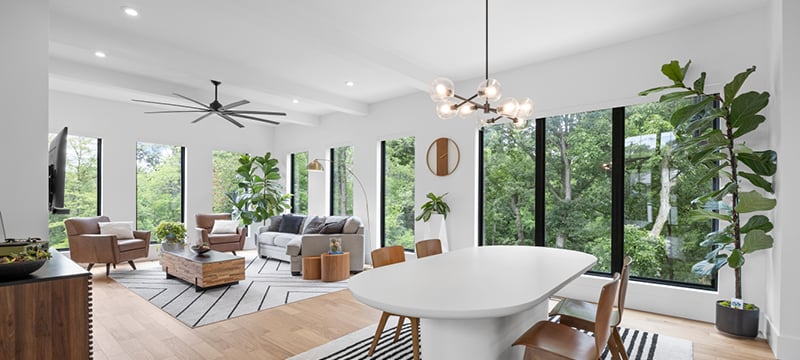
📸 All of these windows—yes, all nine of them—do not open. They’re picture windows, designed to maximize the view with no screens or hardware getting in the way. And because there are no opening mechanisms, that cost could be put toward something much more noticeable: height. These windows are a whopping 7 feet tall, turning the backyard into the artwork.